
- News
- City News
- chennai News
- A stitch in time …
Trending
This story is from August 28, 2023
A stitch in time …
It was 10 years ago that the unique black and white embroidery of the Toda community was awarded a Geographical Indication (GI) tag, making it the only tribal handicraft in the Nilgiris to receive one.
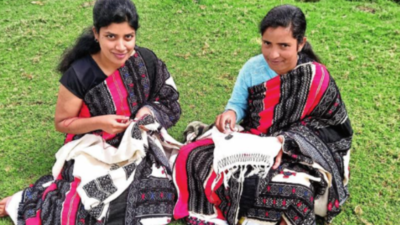
Traditional Toda embroidery does not permit the use of colours other than red and black
But it has been an uphill climb to keep their craft alive, say members of the community, especially since it was near impossible to procure base materials for their embroidery.

The hand-woven half-white base cloth, which is traditionally used for the embroidery, as well as the black and red coloured threads were, initially, supplied by merchants from Wayanad. Later, the Todas procured the materials from Sirumugai near Mettupalayam, says Vijayendra Poof, a Toda woman, who has researched the traditional embroidery.
As time passed, the handwoven base material was replaced by coarsely woven power loom material, while two-ply woolen threads replaced the traditional cotton threads for the embroidery.
The Toda women, says Vijayendra Poof, had to then resort to buying base cloth from the local market in Ooty for exorbitant prices (₹ 700 a metre). “They approached the government to facilitate them with a source of supply of base material and create a proper channel to market their products.”
And that was when the government established the Toda Embroidery Weavers Cooperative Production and Marketing Society Ltd in Ooty in May and recently sanctioned ₹25 lakh for it under the Handloom Support Programme Scheme. “The society will help the community market their products. The society will also authenticate the original craft of the Todas,” says
T Renuka, a Toda, and manager of the society. The scheme was launched state handloom minister R Gandhi.
The society will also provide senior citizen pension, family pension and free electricity to the members. The craft will also be showcased in Co-optex and Poompuhar exhibitions.
Now, the society has gone a step further and is helping the community by supplying base materials for their traditional embroidery, says Renuka. The Todas can now procure the material for ₹200 a metre.
“Women in our community are working hard to keep this unique art alive. Till date, the art is meticulously being passed on from generation to generation. In the early days, the Toda style of embroidery, known as ‘pugur’, used wild flowers as the base and the thin skin of a wild plant as threads,” says Thekish Kuttan alias Mohan, one of the Toda leaders from Muthanad mund near Ooty. Around 1,700 Todas live in 67 munds (hamlets) in the Nilgiris.
Later, the tribals crafted their embroidery on long robes, called ‘poothukuli’, which the community wears for their traditional rituals such as weddings or funerals. The embroidery is composed of red and black bands giving the robe an embossed look. The community has now branched out into embroidering table mats and runners, bags and pillow covers.
The main motif used in the embroidery is the buffalo horn as the Todas worship the buffalo. Other designs include flowers, mountains, rivers and valleys. “The embroidery is done by counting the threads and design by mental calculation. And as the embroidery is done on the reverse of the cloth the product has a rich embossed effect on the surface,” says Anandha Malli, a Toda woman.
“The women imagine a design in their mind and apply the same while doing the embroidery. It requires patience.”
Traditional Toda embroidery does not permit the use of colours other than red and black. “Maybe, our ancestors stuck only to those two colours. The patterns, designs and motifs are inspired by nature, elements of nature,” says Vijayendra Poof.
What is worrying now, says Anandha Malli, is that imitations of their embroidery are being sold online. “We hold our craft sacred. We never use the embroidery on shoe fabric. But you find those products online. We want the government to bring in some control measures to safeguard the identity of our art and livelihood. Enforcement by the government plays a vital role when it comes to GI tag.”
End of Article
FOLLOW US ON SOCIAL MEDIA


Photostories

Hot Picks
TOP TRENDING
Popular Categories
Hot on the Web
Top Trends
SA vs WI Live ScoreUGC NET ResultHarbhajan SinghAbhimanyu EaswaranShailaja PaikStock Market TodayHaryana Election ResultIsrael Hezbollah WarNima Hospital Doctor MurderTaylor SwiftTirupati Laddu RowNEET PG SC HearingWomen's T20 World CupTop MBA Colleges of IndiaT20 WC ScheduleWomen T20 World Cup Points TableLive Cricket Score
Trending Topics
Samantha Ruth PrabhuNavratri Colours 2024Navratri Day 2 ColourTMKOC New SonuNaga ChaitanyaDevara CollectionGOAT OTT ReleaseRajinikanthDeepika PadukoneGovindaDevaraGovinda NewsDevara Movie ReviewHealthy RaitasSwatantrya Veer SavarkarColdplay India tour 2025Maa Durga 108 NamesNavratri JewellerySony Bravia 55 inch 4k Ultra HD TVWordle Answer
Living and entertainment
Latest News
5 corporate employees share their workplace horror storiesStart construction on 12th October this Navaratri and you will say WOW!Jr NTR-Hrithik Roshan dance-off in 'War 2' set to be shot during THIS timeYouTube Shorts extends duration to 3 minutesWill join NCP (SP) with supporters, says BJP leader Harshvardhan Patil'Was screaming, hitting him': 5-year-old Florida boy suffers cardiac arrest on Disney rollercoaster ride'We spoke about it and ...': What Trump said on wife Melania backing abortion rights in new memoirTDP welcomes SC's ruling on SIT to probe Tirupati laddu adulterationJannik Sinner not 'comfortable' as doping case clouds Shanghai campaignThis is the stock trading app linked to Rs 500 crore investment fraud; YouTubers Elvish Yadav, Bharti Singh among 5 summonedCongress leader urges West Bengal governor to act against politicians for polarizing votersTwo Indian-Americans among 15 selected for prestigious 2024-2025 White House fellowshipTop Republican urges Biden to rush 2,000-pound bombs to Israel held up over human rights concernsCoin Master free spins and coins for 4 October, 2024: Earn million of coins using today’s linkSolar eclipse 2024 date and time: When is Surya Grahan in October? Will it be visible in India?Surabhi Lakshmi on receiving praise from Akshay Kumar: I never imagined he would remember me; overwhelmed by his words5 activities every child must do to become unstoppableNidec accelerates Commercial Vehicle electrification in India with Ashok Leyland partnership, Indian footprint investments
Copyright © 2024 Bennett, Coleman & Co. Ltd. All rights reserved. For reprint rights: Times Syndication Service